Survival Mode Is Not a Personality Trait — It’s a Nervous System State

Why people recovering from life disruption struggle to seek help, and why professionals must intervene sooner
Many adults navigating major life change—loss, illness, caregiving collapse, divorce, displacement, retirement shock, or identity disruption—are not “resistant to help.”
They are in survival mode.
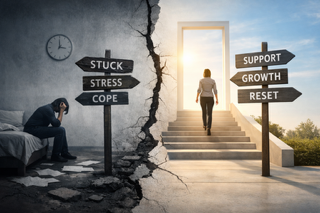
Survival mode is not a mindset someone chooses. It is a physiological and psychological state in which the nervous system prioritizes immediate functioning over reflection, planning, or self-advocacy. When someone is operating here, their world becomes small: get through today, manage the next task, hold it together.
From the outside, these individuals often appear “fine.” They are still showing up. Still functioning. Still saying, “I’m okay.” From the inside, they are exhausted, overwhelmed, and disconnected from any sense of agency.
Why survival mode makes help invisible
One of the most misunderstood aspects of survival mode is this:
the very state that requires support is the same state that prevents someone from seeking it.
When a person is stuck in survival mode:
They normalize chronic stress and emotional depletion
They minimize their own needs because “others have it worse”
They assume this phase will pass if they just endure long enough
They lack the cognitive and emotional bandwidth to evaluate options
They often believe needing help is a failure, not a signal
As a result, many people lose years simply enduring. Grinning and bearing it. Waiting for things to get better on their own.
They are not lazy.
They are not unaware.
They are not choosing stagnation.
They are trapped in a system designed to conserve energy, not expand possibility.
Why this matters to professionals
For those of us working in healthcare, social services, community leadership, human resources, and support roles, this has serious implications.
If we wait for people in survival mode to:
clearly articulate their needs
proactively seek structured support
recognize that they are “allowed” to invest in themselves
…we will wait indefinitely.
Survival mode narrows vision. It suppresses hope—not because hope is gone, but because accessing it feels unsafe.
This is why professionals must name the state, normalize it, and actively guide individuals toward support without diminishing the reality of what brought them there.
Recovery does not require invalidating the cause
There is a common fear among individuals in survival mode:
“If I move forward, it means what happened to me didn’t matter.”
That fear keeps people stuck.
But healing does not erase loss.
Stability does not deny trauma.
Structure does not trivialize hardship.
Programs like The Independent Living Reset are not about “fixing” people. They are about re-establishing internal and external stability so individuals can move out of survival and back into intentional living—at their own pace, with dignity intact.
The cost of staying too long
The longer someone remains in survival mode, the harder it becomes to imagine life beyond it. What begins as coping quietly turns into identity erosion, chronic stress, isolation, and disengagement from opportunity.
Investing in support early is not indulgent.
It is preventative.
It is stabilizing.
It is life-preserving.
A call to action for professionals
We must stop framing help as something people “ask for” when they are ready.
Instead, we must illuminate the path while they are still in the dark.
That means:
Naming survival mode when we see it
Removing shame from structured support
Offering clear, accessible pathways forward
Referring individuals to programs that restore independence, not dependency
People do not need to remain trapped in survival mode to honour what they’ve been through. They can acknowledge the pain and choose support. They can grieve and rebuild. They can survive and reset.
If you work with adults navigating life disruption—or if you recognize yourself in this description—programs like The Independent Living Reset exist to bridge the gap between survival and stability.
Recovery is not a personal failure to overcome alone.
It is a process that deserves structure, compassion, and timely intervention.


Comments